



Three Seconds Is All You Get
Walk through any grocery store, farmers market, or specialty retailer and pay attention to your own behavior. You scan. You slow down when something catches your eye. You pick things up — or you don't. That split-second decision is made almost entirely on visual cues, and your label is responsible for every one of them.
This isn't just intuition. Consumer research consistently shows that packaging and labeling are among the top purchase influencers at the point of sale, often outranking brand familiarity for first-time buyers. For a new beverage launching at a Mizner Park shop, or a specialty food brand debuting at the Delray Beach Green Market, that label may be the only marketing tool in the room.
Getting it right matters enormously.
The Label Is Doing More Work Than You Think
Most business owners think of a label as a container for information — name, ingredients, weight, barcode. And yes, it needs to do all that. But a well-designed label is simultaneously doing several other jobs:
- Positioning your brand — communicating whether your product is premium, approachable, playful, clinical, artisan, or mass-market
- Creating shelf differentiation — giving shoppers a visual reason to pause on your product instead of the one next to it
- Building recognition — consistent visual identity across your product line trains customers to spot you quickly
- Conveying trust — clear, professional design signals that the product inside is worth buying
- Justifying your price point — especially for specialty or premium products, the label quality directly influences a customer's willingness to pay more
A local skincare brand in Palm Beach County selling a $45 facial serum next to a $12 competitor needs a label that visually earns that price difference. Clean typography, premium finish, intentional white space — these aren't aesthetic luxuries, they're sales tools.
What Separates a Professional Label From a Printed Sticker
Not all labels are created equal, and the gap between a professionally printed label and a DIY alternative is immediately obvious — especially in retail environments where your product sits next to competitors who've invested in their presentation.
Here's what actually goes into a high-quality product label:
Material Selection
The substrate matters as much as the design. Options include:
- Matte or gloss paper — clean and cost-effective for dry goods and retail products
- Waterproof BOPP (biaxially oriented polypropylene) — essential for beverages, bath products, anything that gets wet or refrigerated
- Kraft paper — warm, natural look that signals artisan or eco-conscious positioning
- Clear labels — creates a "no-label look" that works beautifully on glass bottles and premium packaging
Finish and Coating
A laminate or coating protects the label and enhances its visual impact:
- Gloss laminate — vibrant, high-contrast, eye-catching
- Matte laminate — sophisticated, tactile, tends to photograph well
- Soft-touch coating — velvety texture that communicates premium quality the moment someone picks it up
- Spot UV — selective gloss coating over specific design elements, creating depth and visual interest
Print Quality
Color accuracy matters. A label that prints slightly off from your brand colors undermines consistency and can make a product look cheap even when the design is solid. Professional label printing uses calibrated equipment and proper color profiles to make sure what comes off the press matches what you designed.
Industry-Specific Considerations for South Florida Businesses
Different product categories carry different label requirements — and in South Florida's climate, durability is always a factor.
Food and Beverage
Labels on food products need to survive refrigeration, condensation, and handling. Waterproof materials and strong adhesives are non-negotiable. Beyond durability, food labels carry specific regulatory requirements — ingredient lists, allergen disclosures, net weight, nutrition facts. A professional printer helps ensure your labels meet FDA compliance standards before they ever hit a shelf.
A beverage startup at a Boca Raton specialty market recently learned this the hard way — their initial DIY labels peeled at the edges after a few hours in an ice bucket. One reorder with the right materials solved the problem, but the first impression was already made.
Health, Beauty, and Wellness
This category lives or dies on perceived prestige. Labels on serums, supplements, and skincare need to communicate efficacy and trust, often with minimal, clean design. Premium finishes — soft-touch, embossing, foil detail on the logo — signal quality in a way that resonates strongly with health-conscious, discerning buyers.
Specialty and Artisan Products
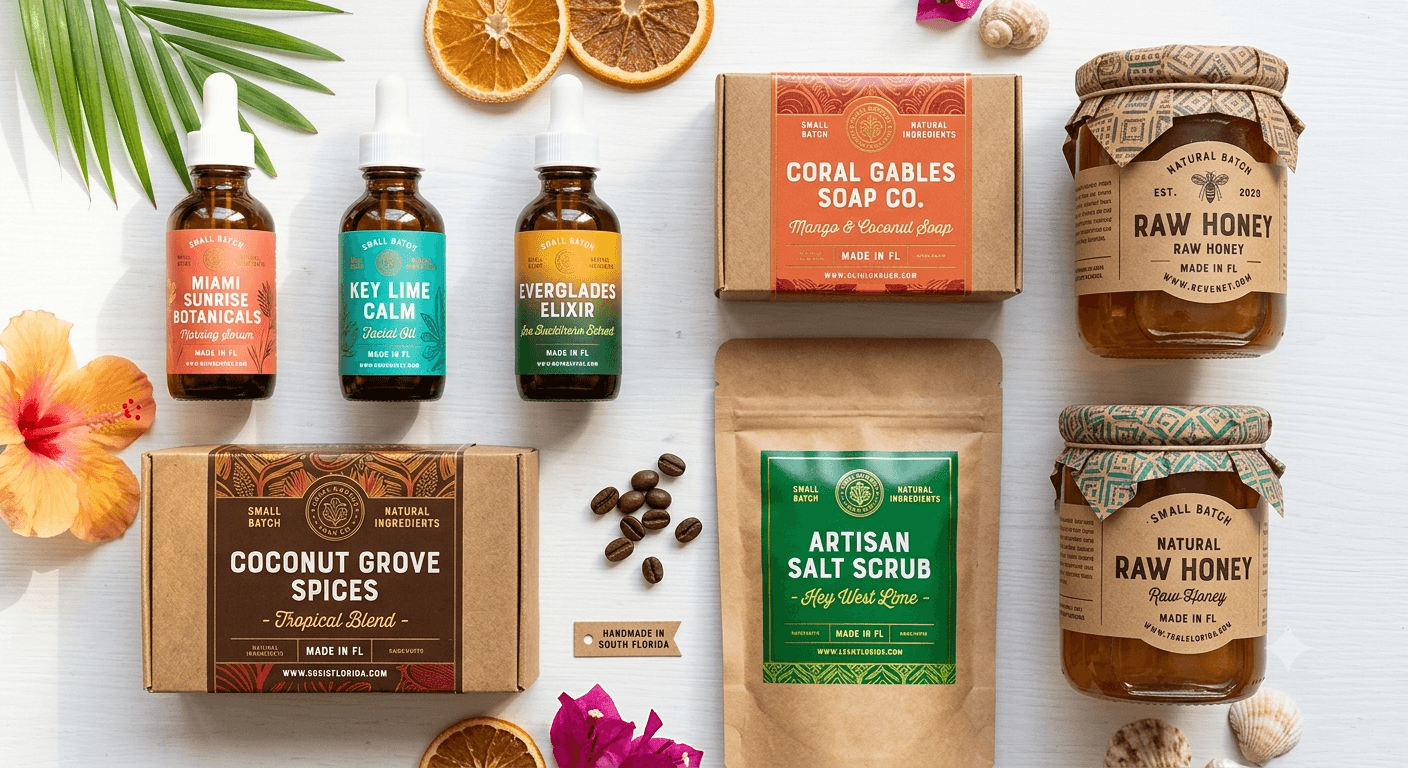
For local makers selling at farmers markets in Delray Beach or through boutique retailers in East Boca, the label needs to tell a story. Origin, craft, ingredients, values — all of this can be communicated visually through design choices like hand-drawn illustrations, warm color palettes, and kraft paper stock. Authenticity sells, and a label that looks artisan earns shelf space in stores that curate carefully.
Common Label Mistakes (and How to Avoid Them)
Even businesses with great products sometimes undermine themselves with label missteps. A few of the most common:
Too much information, not enough hierarchy. If everything is the same size, nothing stands out. Your product name and key differentiator should dominate. Supporting information supports — it doesn't compete.
Fonts that don't match the brand positioning. A casual script on a pharmaceutical supplement or a stiff serif on a children's snack creates subtle but real friction with buyers. Typography communicates personality.
Colors that don't hold in print. Neon colors, very light tints, and intricate gradients can look very different on screen vs. on press. Working with an experienced designer who understands print production prevents expensive surprises.
Ignoring the shape of the container. A label that looks great as a flat design may wrap awkwardly around a cylindrical bottle. Always consider how the label interacts with the three-dimensional surface it's going on.
From Design to Shelf: The Minuteman Press Process
At Minuteman Press Boca Raton, we work with product-based businesses from initial concept through finished labels — whether you're coming in with a fully developed brand or starting from a blank page.
Our graphic design team creates label artwork built for print from the start — right color profiles, proper bleed, and layouts that hold up beautifully at production scale. Our custom label printing capabilities cover everything from small short runs for market testing to larger production quantities for retail rollouts.
We also help you think through the practical side: which material survives your product's conditions, which finish fits your positioning, how to sequence a label reorder to avoid running out mid-season. It's a more complete conversation than just "what size do you need?"
Your Label Is an Investment, Not an Expense
Here's a useful way to frame it: if a better label helps even one in ten customers choose your product over a competitor, that conversion pays for the label upgrade many times over. The math is especially compelling for products with repeat purchase potential — a customer who tries your hot sauce at a Boca Raton market and loves it becomes a multi-year revenue stream. A label that got them to pick it up in the first place earned every cent.
Don't let a weak label be the reason a great product gets overlooked.
CALL US: 561-392-8626 | Get a label printing estimate today →

