



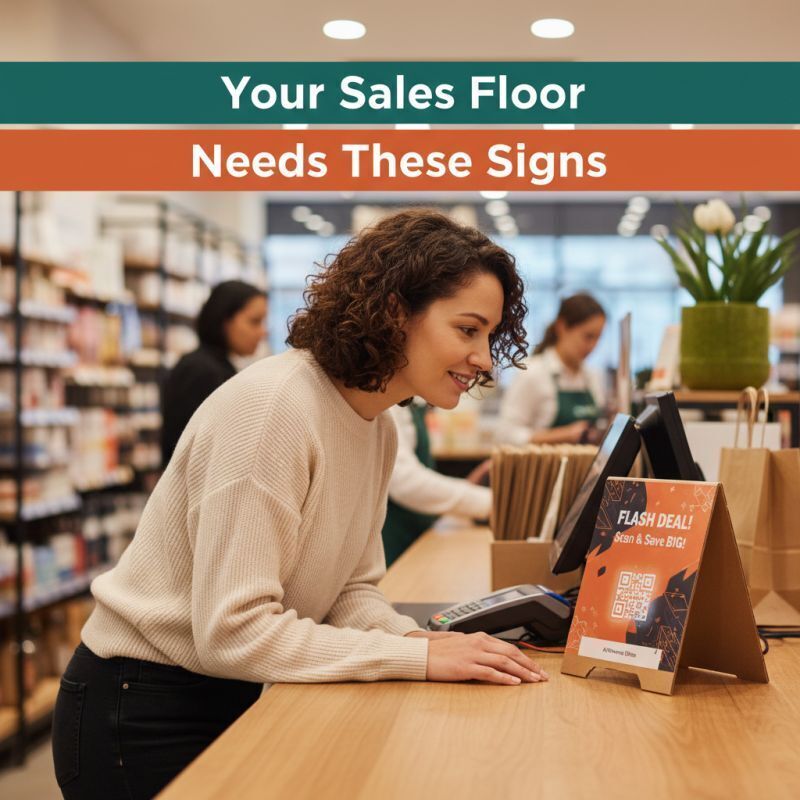
Retail success depends on converting browsers into buyers at the critical moment of decision. Point-of-sale signage captures attention when customers are ready to purchase, turning checkout areas into revenue generators. Professional POS displays deliver measurable returns through increased transaction values and impulse sales.
Why Point-of-Sale Signage Matters for Retail Success
Point-of-sale signage works because it reaches customers at peak buying intent. Your checkout area represents the final opportunity to influence purchase decisions before customers leave your store.
Research shows that 82% of purchasing decisions happen in-store. Customers standing at your register are already committed to buying. Strategic signage at this moment prompts additional purchases without aggressive sales tactics.
Retailers using professional POS displays report 15-30% increases in average transaction value. This happens because well-designed signage reminds customers of complementary products, limited offers, and loyalty programs at exactly the right moment.
Types of Point-of-Sale Signage That Drive Results
Counter signs sit directly at the register where customers wait. These compact displays work for promoting add-on items, payment options, or upcoming sales events. Durability matters here because high-traffic areas require materials that withstand constant handling.
Easel signs stand near checkout lines to capture attention while customers queue. Retailers use these for seasonal promotions, new product launches, or highlighting high-margin impulse items. The key is clear messaging that customers process in 3-5 seconds.
Window clings and decals work for storefronts with visibility into checkout areas. These attract foot traffic while reinforcing in-store promotions. Palm Beach County retailers see strong results with seasonal window displays that preview checkout offers.
Hanging signs above registers maximize vertical space in smaller stores. This keeps counter areas clear while maintaining promotional visibility. Boca Raton boutiques often combine hanging signs with counter displays for layered messaging.
Elements of Effective POS Signage Design
Clear messaging beats creative copy every time. Customers at checkout are focused on completing their purchase. Your signage needs to communicate value in seconds, not paragraphs.
Use specific offers instead of vague promotions. "Buy 2, Get 1 Free" outperforms "Special Deals Today" because it tells customers exactly what they gain. Price anchoring works well too. "$5 Add-On" performs better than "Small Additional Purchase."
Visual hierarchy guides eye movement. Place your strongest offer or call-to-action at the top. Use contrasting colors to separate key information from supporting details. White space prevents cognitive overload.
Brand consistency matters even for promotional signage. Your POS displays should match your overall store aesthetics. This builds trust and makes promotions feel like natural extensions of your brand rather than desperate clearance attempts.
Materials and Durability for High-Traffic Areas
Checkout areas endure constant interaction. Customers lean on counters, merchandise brushes against signs, and cleaning happens daily. Material selection directly impacts signage lifespan and return on investment.
Laminated prints resist moisture and fingerprints. This matters for Florida retail locations where humidity and air conditioning create condensation. Lamination extends sign life from weeks to months.
Rigid substrates like foam board or PVC maintain shape under stress. These materials support larger graphics without warping. Retailers replacing flimsy cardboard signs quarterly save money by investing in durable materials upfront.
Acrylic holders protect paper inserts while allowing quick updates. This works well for frequently changing promotions or seasonal offers. You maintain professional presentation while keeping flexibility for timely updates.
Strategic Placement for Maximum Impact
Sight lines determine signage effectiveness. Position displays where customers naturally look while waiting. This typically means eye level at 5-5.5 feet for standing customers.
Counter placement depends on register configuration. If customers approach from the left, place your primary display on the right side of the register. This catches attention as they complete their transaction.
Distance matters for readability. Signs meant for queue lines need larger text than counter displays. Test visibility from 6-8 feet away for line signage and 2-3 feet for counter signs.
Lighting affects color accuracy and readability. Overhead fluorescent lighting washes out certain colors. Test your designs under your actual store lighting before final production.
Measuring POS Signage Performance
Track specific metrics before and after implementing new signage. Average transaction value provides clear evidence of effectiveness. Compare weekly averages for four weeks before and after installation.
Monitor add-on item sales velocity. If your POS signage promotes a specific product, track its sales during the promotion period. This isolates signage impact from other marketing efforts.
Customer questions about promoted items indicate signage clarity. If staff field fewer questions after installing new POS displays, your messaging is clear. More questions suggest confusing or incomplete information.
Test different messages and designs systematically. Run one promotion for two weeks, then switch to a different offer. Compare results to identify which approaches resonate with your specific customer base.
Local Considerations for Florida Retailers
South Florida retail environments present unique challenges. Humidity affects paper-based signage faster than in dry climates. Choose moisture-resistant materials or protective coatings for longer-lasting displays.
Tourist traffic in Palm Beach County means diverse customer demographics. Your signage needs to communicate clearly across language barriers. Visual elements and simple text work better than elaborate copy.
Seasonal fluctuations require agile signage strategies. Winter season brings different promotional opportunities than summer months. Plan your POS signage calendar around local tourism patterns and shopping behaviors.
Hurricane season preparedness includes securing or removing temporary signage. Wind and water damage portable displays. Build this into your signage budget and replacement planning.
Common POS Signage Mistakes to Avoid
Overcrowding your checkout area with multiple competing messages confuses customers. Focus on one primary offer per display location. Three counter signs promoting different items perform worse than one clear promotion.
Using small text forces customers to lean in and squint. This creates awkward interactions and often gets ignored. Minimum text size should be readable from your typical queue distance.
Neglecting updates makes your store look stale. Customers notice when promotional signage stays up past its end date. This damages credibility for future offers.
Ignoring brand guidelines creates visual chaos. Your POS signage should feel cohesive with your overall store design. Mismatched colors and fonts signal poor attention to detail.
Integration with Overall Marketing Strategy
POS signage works best when coordinated with other marketing channels. If you run email promotions, reinforce them at checkout. This repetition increases conversion rates.
Social media announcements gain traction when supported by in-store visibility. Customers seeing your promotion both online and at checkout perceive it as more valuable.
Staff training amplifies signage effectiveness. Employees who understand promoted offers provide better service. Brief your team whenever you update POS displays.
Loyalty programs benefit from consistent POS reminders. Members see their benefits acknowledged at checkout. New customers learn about enrollment opportunities at peak interest moments.
Cost-Benefit Analysis of Professional POS Signage
Quality signage requires upfront investment but delivers ongoing returns. A $200 professionally designed counter display that increases average transaction value by $3 pays for itself after 67 transactions.
DIY solutions often cost more long-term. Homemade signs look unprofessional and require frequent replacement. Time spent creating and updating DIY displays has opportunity cost.
Bulk ordering reduces per-unit costs. Planning your signage calendar quarterly allows for cost-effective production runs. You maintain consistent quality while managing expenses.
Professional design expertise prevents costly mistakes. Experienced designers understand visual hierarchy, color psychology, and readability standards. This knowledge translates to better-performing signage.
Technology Integration in Modern POS Displays
Digital displays offer dynamic content capabilities. You update promotions instantly without reprinting. Initial costs are higher but flexibility often justifies the investment for high-volume retailers.
QR codes bridge physical and digital experiences. Customers scan codes at checkout to access loyalty programs or exclusive online offers. This captures data while providing value.
NFC tags enable contactless interactions. Customers tap their phones to receive promotion details or sign up for newsletters. This technology particularly appeals to younger demographics.
Static signage remains effective for many applications. Not every promotion requires digital capabilities. Match your technology investment to your specific goals and customer preferences.
CONCLUSION
Strategic point-of-sale signage transforms your checkout area into a revenue-generating asset. Professional design and quality materials deliver measurable returns through increased transaction values and impulse purchases. Minuteman Press Boca Raton specializes in creating custom POS displays that match your brand while driving sales. Our team handles design, material selection, and production to ensure your signage performs in real-world retail conditions.
Request your estimate today at 561-392-8626 or visit Request an Estimate to start designing a poster that delivers workplace wellness results.
FAQ SECTION
Q: What types of businesses in Boca Raton benefit most from POS signage? A: Retail stores, restaurants, boutiques, salons, and service businesses with physical locations all see results from strategic POS displays. Boca Raton businesses with tourist traffic particularly benefit because signage communicates without requiring staff interaction. Any business with a checkout or service counter should consider professional POS signage.
Q: How long does POS signage typically last in South Florida climate? A: Properly laminated and sealed signage lasts 6-12 months in air-conditioned retail environments. Outdoor or high-humidity locations may require replacement every 3-6 months. We recommend moisture-resistant materials and protective coatings for Palm Beach County businesses. Regular inspection helps identify when replacement is needed.
Q: Can you match existing brand colors and fonts for consistency? A: Yes. We work with your brand guidelines, logos, and existing marketing materials to ensure perfect consistency. Our design team uses professional color matching and maintains your brand standards across all signage. This creates cohesive in-store experiences that strengthen brand recognition.
Q: What is the typical turnaround time for custom POS signage orders? A: Standard orders complete within 5-7 business days. Rush service is available for urgent needs. Complex designs or specialty materials may require additional time. We provide accurate timelines during initial consultation and keep you updated throughout production.
Q: Do you offer design services or do I need finished artwork? A: We offer complete design services from concept to final production. Bring your ideas, existing materials, or rough sketches and our team creates professional designs optimized for your space and goals. We also work with your provided artwork if you have finished files.

