



Medical offices in Boca Raton and Palm Beach County face a challenge that costs them thousands of dollars each year. Patients miss appointments at rates between 15% and 30%, staff spend countless hours giving directions, and first impressions often fall flat. The solution starts with something surprisingly simple: professional print materials that guide, educate, and remind patients at every touchpoint
1. The Hidden Cost of Poor Patient Communication
Patient no-shows drain medical practices of revenue and efficiency. Research published in The American Journal of Medicine found that practices without reminder systems experience no-show rates of 23.1%. Those with staff-delivered reminders dropped that rate to 13.6%. The difference represents real money: empty appointment slots, wasted staff time, and delayed care for patients who need it.
Healthcare facilities also lose money when patients get lost. Studies show that 85% of patients ask for directions when visiting medical facilities, and 30% of first-time visitors get lost. One university health system calculated that poor wayfinding cost them more than $200,000 annually in late arrivals, missed appointments, and staff time spent giving directions.
For medical practices in Palm Beach County, where competition among healthcare providers is high, these inefficiencies create a serious disadvantage. Patients who feel confused or frustrated from their first visit are less likely to return or recommend your practice to others.
2. Essential Print Materials for Every Medical Practice
2.1 Appointment Cards and Reminder Systems
Physical appointment cards serve a purpose that digital reminders cannot fully replace. While automated text messages reduce no-show rates by up to 50%, research shows that patients who receive physical reminders alongside digital ones demonstrate the highest attendance rates. A tangible card on a refrigerator or in a wallet provides a constant visual reminder that electronic notifications cannot match.
Effective appointment cards include more than just date and time. They feature your practice name and logo prominently, provide clear contact information for rescheduling, include preparation instructions when relevant, and reinforce your brand identity with professional design. Cards printed on quality cardstock signal that your practice values attention to detail.
2.2 Patient Education Brochures
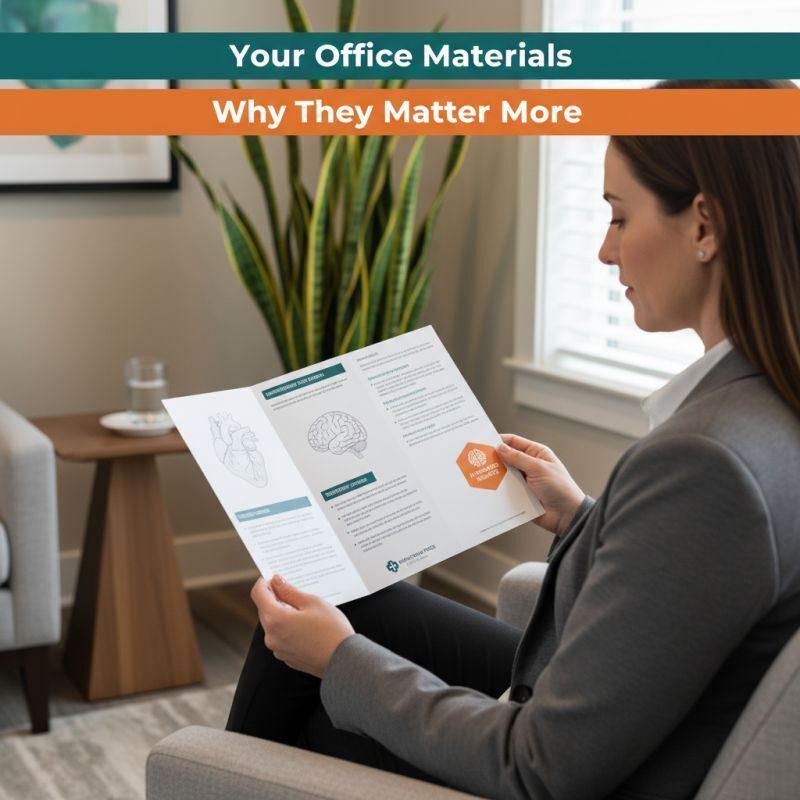
Research in Health Expectations found that patient information leaflets improve knowledge, satisfaction, and treatment adherence across clinical situations. When physicians have less time to spend with each patient, printed brochures bridge the communication gap effectively.
Studies examining waiting room materials found that 78% of patients notice health education materials, and 68% find them useful. The key is creating brochures that simplify complex medical information into clear, accessible language with helpful visuals. Parents facing a child's dental procedure, patients managing chronic conditions, or individuals preparing for surgery all benefit from take-home materials they can reference after leaving your office.
Medical brochures work best when they address specific conditions or procedures, include step-by-step instructions patients can follow at home, feature visual elements that clarify complex concepts, and provide contact information for follow-up questions.
2.3 Custom Administrative Forms
Every patient interaction involves paperwork. Custom intake forms, consent documents, medical history questionnaires, and billing forms represent your practice at crucial moments. Poorly designed forms create frustration, slow down workflows, and increase errors in data collection.
Professional forms feature logical organization that guides patients through the information you need. Clear typography ensures readability for patients of all ages. Adequate spacing prevents cramped writing and scanning difficulties. Your practice logo and consistent branding reinforce professionalism with every page.
For medical practices handling sensitive information, forms printed on quality paper stock convey security and legitimacy. HIPAA-compliant design elements, clear disclosure language, and professional presentation all contribute to patient confidence.
2.4 Interior and Exterior Signage
Wayfinding signage reduces stress for patients and saves staff time. Healthcare signage research demonstrates that effective navigation systems reduce anxiety, improve punctuality, minimize staff interruptions, and enhance overall patient experience.
Medical offices need several types of signage. Exterior signs help patients identify your building and find parking. Lobby directories orient visitors upon entry. Directional signs guide movement through hallways and between floors. Department identifiers mark clinical areas. Room signs identify exam rooms, restrooms, and offices. ADA-compliant signage ensures accessibility for patients with visual impairments.
Consistent branding across all signage reinforces your practice identity. Patients who see the same colors, fonts, and design elements from the parking lot to the exam room develop familiarity and trust. This consistency also helps patients navigate any location in a multi-site practice network.
2.5 Professional Stationery
Business cards, letterhead, and envelopes carry your practice identity into the broader community. Referral letters to specialists, correspondence with insurance companies, and communications with patients all benefit from professional presentation.
Quality stationery signals credibility. Physicians referring patients to your practice form impressions from the materials they receive. Insurance adjusters processing claims notice presentation quality. Patients receiving test results or billing statements judge your professionalism partly by the paper in their hands.
Coordinated stationery packages ensure consistency. Matching business cards, letterhead, envelopes, and notepads project an organized, detail-oriented practice. For South Florida medical offices competing for patients, these details differentiate your practice from less polished competitors.
3. Direct Mail Strategies That Drive Patient Acquisition
Healthcare direct mail campaigns deliver results that digital channels struggle to match. Industry research shows that 76% of consumers read direct mail from healthcare providers, compared to email open rates between 20% and 25%. Patients recall brands from direct mail 75% of the time versus 44% for digital-only exposure.
Marketing professionals report that 84% find direct mail delivers the highest ROI of any channel they use. Healthcare direct mail campaigns achieve average response rates of 5.1%, significantly higher than typical digital advertising benchmarks.
Effective healthcare direct mail includes new patient welcome campaigns that introduce your practice to residents who recently moved to Boca Raton or Palm Beach County. Recall postcards remind patients when annual exams, screenings, or follow-up appointments are due. Service announcements introduce new providers, expanded hours, or additional treatment options. Health education mailers position your practice as a trusted resource for wellness information.
Direct mail works particularly well for healthcare because patients trust mail from their doctors. Unlike promotional emails that feel intrusive, a postcard from a physician feels personal and legitimate. This trust translates into action: scheduling appointments, returning for recommended care, and referring friends and family.
4. Building Trust Through Quality and Consistency
Research on signage effectiveness shows that 79% of people associate good signage with high-quality products or services. This perception extends to all print materials. Patients consciously or unconsciously evaluate your practice based on every piece of paper, every sign, and every printed communication they encounter.
Consistency matters as much as quality. When your appointment cards match your lobby signage, which matches your letterhead, which matches your patient brochures, you create a cohesive brand experience. Patients develop confidence in practices that present themselves professionally at every touchpoint.
For medical practices, trust is foundational. Patients share sensitive health information, undergo procedures, and follow treatment recommendations based on their confidence in your expertise and professionalism. Print materials either reinforce or undermine that confidence with every interaction.
5. Why South Florida Medical Practices Choose Local Print Partners
Medical offices in Boca Raton and Palm Beach County benefit from working with local print providers who understand the regional healthcare landscape. Florida hosts over 13,000 healthcare facilities, and Palm Beach County features a competitive mix of high-end care facilities and widespread healthcare availability.
Local print partners offer advantages that remote vendors cannot match. Quick turnaround times mean you receive materials when you need them, not weeks later. In-person consultations ensure your branding translates correctly to print. Design expertise helps medical practices present themselves professionally. Knowledge of local regulations and standards prevents compliance issues.
Minuteman Press Boca Raton brings decades of experience serving South Florida businesses, including medical practices throughout Palm Beach County. Our in-house team of college-educated graphic designers transforms your ideas into professional marketing materials. We combine design expertise with precision print production to deliver materials that meet healthcare industry standards.
6. Getting Started with Professional Print Materials
Upgrading your practice's print materials does not require overhauling everything at once. Start with the items patients encounter most frequently: appointment cards, intake forms, and basic signage. These high-impact items deliver immediate improvements in patient experience and operational efficiency.
Next, evaluate your patient education materials. Do your brochures address the conditions and procedures you handle most often? Are they current, accurate, and professionally designed? Outdated or poorly designed materials undermine patient confidence.
Finally, consider your external communications. Direct mail campaigns can drive new patient acquisition while reinforcing relationships with existing patients. Coordinated stationery ensures professional presentation in every letter and referral you send.
A professional print partner can audit your current materials and recommend priorities based on your practice goals and budget. The investment in quality print materials pays returns through reduced no-shows, improved patient satisfaction, and enhanced professional reputation.
Article Conclusion
Professional print materials transform how patients perceive and interact with your medical practice. From the appointment card that reduces no-shows to the signage that eliminates confusion, every printed piece contributes to patient trust and operational efficiency. Medical offices throughout Boca Raton, Palm Beach County, and South Florida rely on Minuteman Press for patient education brochures, custom administrative forms, professional signage, appointment cards, and complete stationery packages. Contact Minuteman Press Boca Raton at 561-392-8626 or visit Request an Estimate to discuss your practice's print material needs with our experienced design and production team.

