



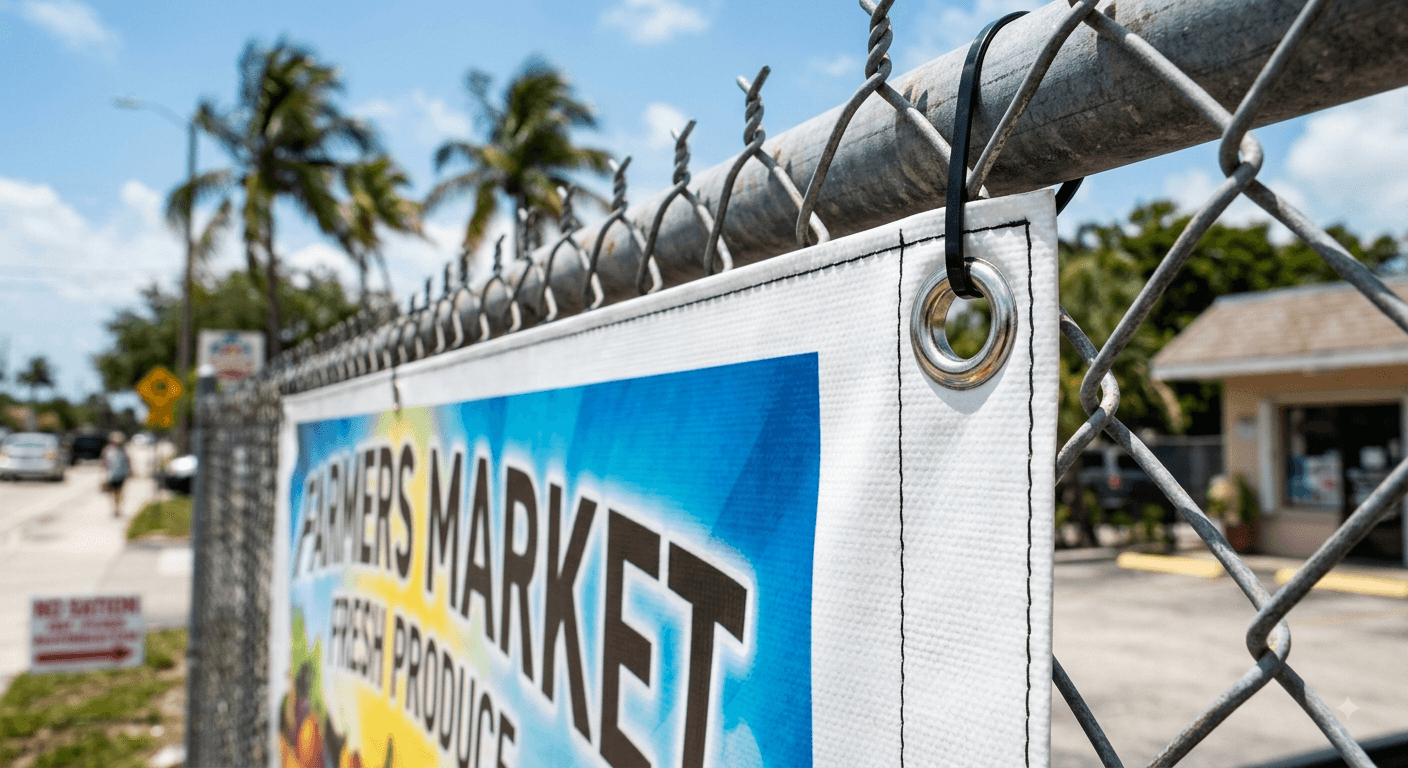
A banner's hems and grommets matter more than its graphic design when it comes to how long it actually survives outdoors, because South Florida wind doesn't care how good your logo looks — it cares whether the edges hold. Skip the reinforcement and even a beautifully printed banner can rip apart in a single afternoon storm.
What actually makes a banner fall apart outdoors?
It's almost never the print itself — it's the edges and the mounting points. Wind doesn't push evenly across a banner; it catches the corners and edges first, and that's exactly where a raw, unfinished edge starts to fray and tear. Once one grommet hole stretches or tears out, the load shifts to its neighbors, and the failure cascades from there.
This is why two banners with identical artwork can have completely different lifespans. The difference is almost always in the finishing you can't see in a design proof.
What a reinforced hem is actually doing
A hem folds the banner material back on itself along every edge, usually with a welded or sewn seam, so the edge is now two or more layers thick instead of one. That extra layer does two jobs: it stops the raw edge from fraying in the wind, and it spreads tension across a wider area instead of concentrating it on a single thin edge. It's the same principle as hemming a pair of pants, just engineered for load-bearing instead of appearance.
Without a hem, a banner's edge is only as strong as the thinnest point of the material. With one, the edge is reinforced exactly where the stress concentrates.
Why grommets, and why placement matters
A grommet is a small metal ring set into a punched hole in the banner, and its job is to keep that hole from stretching, tearing, or fraying every time the banner is tied down, zip-tied to a fence, or clipped to a frame. Without one, a rope or zip tie eventually saws right through unreinforced vinyl or fabric — especially in wind gusts, when the fabric is snapping back and forth against the tie point dozens of times a minute.
Placement matters as much as the grommet itself. Corners and midpoints along every edge need coverage so no single attachment point is carrying more load than it should. A banner with grommets only in the corners will sag and flap in the middle — and that flapping is exactly what accelerates tearing.
Why this matters more in Boca Raton than in a lot of markets
South Florida's afternoon thunderstorms bring sudden wind gusts that most outdoor banners have to survive without warning. A charity marathon marking the route through Mizner Park can't send someone out to check every banner between the morning setup and the afternoon storm cell. A restaurant grand opening with a street-facing banner in downtown Boca Raton might have that banner up for weeks in the sun and rain before the buzz even peaks. In both cases, the finishing decisions made before printing determine whether the banner is still legible — and still up — by the time it matters most.
A school running a fall festival with an entrance banner and yard signs across a Palm Beach County campus faces the same math on a smaller scale: it only takes one gust to turn a promotional asset into a liability if the finishing wasn't built for the job.
What this protects, beyond the banner itself
A banner that tears apart mid-campaign doesn't just need replacing — it stops doing its job right when you need it most, whether that's an event weekend or a grand opening's most visible days. Reordering under time pressure usually means paying a rush fee for something that didn't need to fail in the first place. Proper hems and grommets are a small line item that prevents a much bigger one.
There's a brand angle too: a torn, sagging banner reads as neglect even when the business behind it is anything but. A banner that's still crisp and intact after weeks outdoors quietly reinforces that the business pays attention to details.
Building a banner that needs to survive outdoors?
Call 561-392-8626 for a custom banner quote with the right hems and grommets for your setup.

