



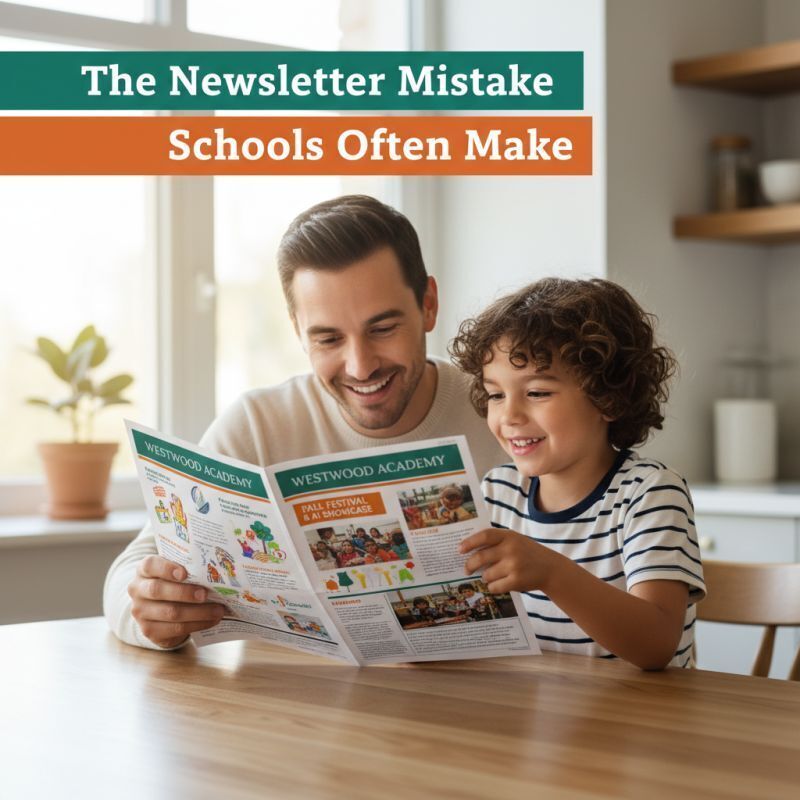
Digital fatigue is real. Your school or nonprofit sends emails that never get opened. Text messages disappear in notification overload. Social media posts get buried under algorithm changes. Meanwhile, professionally printed newsletters sit on kitchen counters for weeks, referenced multiple times by parents and stakeholders who value tangible communication they can trust.
The Trust Gap Digital Communication Cannot Bridge
Research from print marketing studies shows 82% of consumers trust printed materials more than digital advertisements when making decisions. For schools and nonprofits in Boca Raton and Palm Beach County, this trust factor translates directly to engagement outcomes.
Parents receive an average of 60-100 emails weekly from various sources. Email open rates for educational institutions average just 38% according to 2024 data. Your carefully crafted message about the upcoming parent-teacher conference competes with promotional emails, social media alerts, and work communications. Most parents scan their inbox in under five minutes, making split-second decisions about what deserves attention.
Printed newsletters eliminate this competition. They arrive in mailboxes with the same authority as official correspondence. Parents set them on counters or refrigerators where family members encounter them multiple times throughout the week. This repeated exposure builds familiarity and trust that digital channels struggle to achieve.
What the Numbers Say About Print vs Digital
Studies tracking brand recall demonstrate that printed materials achieve 70-80% higher recall rates than digital content. Readers remember what they see in print. The physical interaction of handling paper, the visual layout, and the ability to reference information later all contribute to stronger memory formation.
Canada Post Research found that physical mail triggers 29% higher brand recall than digital messaging. For schools communicating calendar dates, policy changes, or fundraising goals, this recall advantage directly impacts whether parents take action.
The average printed newsletter remains in households for 17 days compared to seconds for digital content. Your February newsletter discussing spring break schedules stays visible on the kitchen counter through multiple family conversations. Parents consult it when planning vacations, arranging childcare, and coordinating with other families.
Breaking Through to Busy Parents
Fewer than 40% of families report receiving regular, helpful communication from their schools according to 2024 school-family dynamics research. This communication gap creates frustration, reduces parent participation in school events, and weakens the home-school partnership that research consistently links to better student outcomes.
Digital communication platforms compound this problem. Email filters sort messages into promotional folders parents rarely check. Text message preferences vary widely among families. Mobile apps require downloads, logins, and regular checking that busy parents struggle to maintain.
Printed newsletters solve these friction points. They require no technology access, no login credentials, and no checking multiple platforms. Every household receives the same high-quality communication regardless of their digital preferences or capabilities.
The Professional Presentation Advantage
Premium paper stock and vibrant full-color printing from Minuteman Press Boca Raton creates immediate visual impact. Parents recognize professional quality. The weight of the paper, the clarity of images, and the polished layout signal that your institution values excellence in all communications.
This professional presentation builds institutional credibility. A well-designed, professionally printed newsletter demonstrates organizational competence. Parents infer that a school or nonprofit capable of producing quality communications will demonstrate the same attention to detail in their core mission.
Visual hierarchy guides readers through information effortlessly. Headlines announce key dates. Photos showcase student achievements. Callout boxes highlight urgent information. Families can scan the newsletter in under three minutes and extract the information most relevant to them.
Real-World Application for Educational Institutions
Consider a Boca Raton elementary school distributing quarterly newsletters to 600 families. Each newsletter highlights upcoming events, policy updates, curriculum changes, and student spotlights. The print format allows parents to post the calendar page on their refrigerator for quick reference throughout the quarter.
Parent-teacher conference attendance increased 23% after the school implemented professionally printed newsletters according to similar institutions tracking engagement metrics. Parents arrived better prepared because they had reviewed teacher profiles and conference goals printed in the newsletter. The physical document prompted family discussions about academic progress before the scheduled meetings.
The school also included fundraising information in each newsletter. Donor response rates for annual giving campaigns improved 18% compared to email-only appeals. The printed format allowed the development office to include compelling student stories with professional photography that resonated with potential donors.
Why This Matters for Boca Raton Nonprofits
Nonprofit organizations face unique communication challenges. Donors, volunteers, board members, and service recipients all need different information. Digital communication requires maintaining multiple mailing lists, segmenting audiences, and hoping recipients check their email regularly.
Printed newsletters create a unified communication piece that serves multiple audiences simultaneously. A feature story about program impact engages donors. Volunteer opportunities appeal to community members wanting to help. Success metrics demonstrate organizational effectiveness to board members. Service announcements inform program participants.
The newsletter economy nearly doubled from 26,911 to 52,809 publications between 2023 and 2024 according to industry tracking data. Organizations recognize that physical communication creates deeper engagement than digital alternatives. This growth occurs while email marketing experts debate declining open rates and increasing spam filters.
The Florida Climate Consideration
South Florida's unique environment presents specific considerations for printed materials. UV resistance matters for newsletters displayed near windows. Humidity resistance ensures paper quality doesn't degrade in coastal conditions. Hurricane season demands communication methods that don't depend on electricity or internet access.
Professionally printed newsletters from Minuteman Press Boca Raton use paper stock and inks designed for Florida conditions. Materials maintain quality in high humidity. Colors resist fading from intense sunlight. The physical format ensures families can reference critical information even during power outages when digital communication fails.
Storm preparation checklists, emergency contact updates, and campus closure procedures printed in newsletters remain accessible when families need them most. Digital messages disappear when phones lose battery power or internet service fails. Printed materials stay reliable regardless of infrastructure challenges.
Cost-Effectiveness Analysis
Schools and nonprofits operating on limited budgets understandably scrutinize communication costs. Digital options appear free on the surface but hide significant expenses. Staff time managing multiple platforms, troubleshooting delivery failures, and responding to parents reporting they never received messages adds up quickly.
Email marketing platforms charge based on subscriber counts and sending volume. Text messaging services bill per message. Mobile apps require ongoing maintenance fees. Social media management demands constant content creation and monitoring. These costs accumulate while engagement metrics disappoint.
Printed newsletters create predictable budgeting. Production costs remain stable. Delivery happens through existing postal services or student backpack distribution. No platform fees, software subscriptions, or technical support contracts required. Organizations gain complete control over timing, content, and distribution.
Response tracking through unique phone numbers or QR codes provides measurable results. Schools can calculate exactly how many parents called about the open house after reading the newsletter. Nonprofits measure donation responses to specific appeals. This attribution clarity helps justify communication budgets to administrators and board members.
The Snowbird Population Factor
Palm Beach County experiences significant seasonal population changes. Winter residents arrive in November and depart in April. These seasonal residents often include grandparents actively involved in grandchildren's education and retirees supporting local nonprofits.
Printed newsletters reach this demographic effectively. Many snowbirds maintain limited digital presence during their Florida stay. They prefer tangible mail they can review at leisure. Professional print quality aligns with their expectations for how respected institutions communicate.
This population also represents significant fundraising potential for nonprofits. Major donors in the 65+ age bracket respond better to printed appeals according to nonprofit fundraising research. The newsletter format allows organizations to showcase impact stories and financial stewardship in a format this donor demographic prefers and trusts.
Design Elements That Drive Engagement
Effective newsletter design balances information density with visual breathing room. Every element serves a purpose. Headlines grab attention. Subheadings organize content. Photos create emotional connections. White space prevents overwhelming readers.
Color psychology influences reader response. Educational newsletters benefit from blues and greens that convey stability and growth. Nonprofit publications use warmer tones like orange and yellow to communicate optimism and community. Minuteman Press Boca Raton's design team understands these principles and implements them strategically.
Typography choices impact readability. Serif fonts like Georgia work well for longer text sections. Sans-serif fonts like Arial excel for headlines and callouts. Font size and line spacing accommodate various reading abilities. Professional design ensures every family member can easily consume the content.
Multi-Channel Integration Strategy
Print newsletters work most effectively as part of an integrated communication strategy. The newsletter announces upcoming events and directs readers to your website for registration. A QR code links to a video tour of your new facility. The physical document serves as the entry point to deeper digital engagement.
This approach leverages the strengths of both formats. Print provides the trust, permanence, and broad reach. Digital offers interactivity, real-time updates, and detailed information that would overwhelm a printed page. Together they create a comprehensive communication system that serves diverse family preferences.
Social media posts can highlight newsletter content and drive traffic to the full publication. Email reminders let families know to watch their mailbox for the upcoming newsletter. Each channel reinforces the others while respecting that different families prefer different communication methods.
Production Timeline and Planning
Successful newsletter programs require systematic planning. Quarterly publications work well for schools aligning with grading periods. Monthly newsletters suit nonprofits with frequent programming updates. The key is consistency. Families and donors come to anticipate and look for your communication.
Content collection begins six weeks before publication. Schools gather student achievement stories, teacher features, and upcoming event details. Nonprofits compile program updates, volunteer spotlights, and impact statistics. This lead time allows thorough fact-checking and professional photography.
Design development takes two weeks. Minuteman Press Boca Raton's team creates layouts that optimize information hierarchy and visual appeal. Rounds of review ensure accuracy and alignment with brand guidelines. Print production requires one week including proofing, printing, and quality checks before delivery.
Measuring Newsletter Impact
Effective measurement demonstrates ROI and guides continuous improvement. Schools track attendance at events promoted in newsletters compared to events promoted only digitally. The comparison reveals print communication's impact on parent participation.
Nonprofits monitor donation responses by including unique response mechanisms in printed appeals. A special phone number listed only in the newsletter. A specific donation designation that can only be known from reading the print piece. These tools attribute gifts directly to newsletter exposure.
Surveys provide qualitative feedback. Include a brief feedback card in occasional newsletters asking families to rate usefulness and suggest improvements. Response rates for printed surveys exceed digital survey participation significantly. Parents appreciate the opportunity to influence future communications.
Website traffic spikes following newsletter distribution reveal digital engagement driven by print promotion. Analytics show increased visits to pages featured in the newsletter. This demonstrates how print serves as a gateway to deeper digital interaction for parents ready to learn more.
Overcoming Common Objections
School administrators and nonprofit leaders sometimes express concern about environmental impact. Modern printing uses vegetable-based inks and recycled paper options. Minuteman Press Boca Raton offers sustainable materials that reduce environmental footprint while maintaining professional quality.
The targeting precision of printed newsletters actually reduces waste compared to mass digital campaigns. You print exactly the quantity needed for your confirmed family count. No spam filters create waste by blocking messages from reaching intended recipients. No unopened emails clutter servers indefinitely.
Some organizations worry that younger parents prefer digital-only communication. Research contradicts this assumption. Parents across all age groups value multiple communication options. Millennials and Gen Z parents appreciate tangible materials they can reference without screen time. The key is offering both print and digital to accommodate all preferences.
Professional vs DIY Comparison
Schools and nonprofits sometimes attempt DIY newsletter production to save money. Staff create layouts in word processors. Desktop printers produce copies. Student volunteers fold and distribute. The result looks amateur and undermines institutional credibility.
Professional printing delivers noticeable quality differences. Color accuracy ensures your school colors reproduce correctly. Paper quality creates substantial feel that communicates importance. Cutting and folding precision produces crisp edges and professional presentation. These details matter to perception.
Time savings justify professional production costs. Staff redirect hours spent troubleshooting printer issues and managing supplies toward mission-critical work. The stress of deadline pressure and technical problems disappears. Your team focuses on content quality rather than production logistics.
The Local Advantage
Working with Minuteman Press Boca Raton provides distinct benefits over online printing services. Local consultation ensures designs meet your specific needs. Face-to-face meetings clarify requirements and resolve questions quickly. You review physical proofs before final printing rather than hoping colors appear correctly when delivered from distant facilities.
Rush production accommodates urgent needs. When the superintendent needs to communicate a policy change, local production delivers finished newsletters in days not weeks. Your proximity to the print shop means same-day pickup or immediate local delivery when timelines compress.
Understanding local context improves results. Minuteman Press Boca Raton knows Palm Beach County demographics, seasonal patterns, and community expectations. This knowledge informs design recommendations and content suggestions that resonate with your specific audience.
Start Building Stronger Connections Today
Your school or nonprofit deserves communication tools that actually work. Parents and donors deserve information in formats they trust and reference regularly. Professionally printed newsletters bridge the gap between institutional messaging and family engagement.
The investment in quality print communication returns measurable improvements in participation, giving, and overall satisfaction. Your message reaches families reliably regardless of digital access or email habits. The tangible presence of a well-designed newsletter creates ongoing dialogue opportunities that ephemeral digital content cannot match.
CONCLUSION
Digital communication will never disappear, but it cannot carry your entire outreach burden. Families value institutions that communicate through multiple channels respecting different preferences and constraints. Professionally printed newsletters from Minuteman Press Boca Raton demonstrate your commitment to clear, reliable, professional communication.
Ready to improve how your school or nonprofit connects with stakeholders? Contact Minuteman Press Boca Raton to discuss your newsletter needs. Our team understands educational and nonprofit communication requirements. We deliver quality printing that enhances your institutional image while keeping families and supporters engaged.
Call 561-392-8626 to schedule a consultation or REQUEST AN ESTIMATE HERE. Let us show you how professional print communication strengthens relationships and drives results for Boca Raton schools and nonprofits.
FAQ SECTION
Q: How much does professional newsletter printing cost for a typical Boca Raton school? A: Newsletter printing costs depend on quantity, page count, and finish options. A typical school printing 500 copies of a 4-page color newsletter runs $400-600. This breaks down to approximately $1 per newsletter delivered to families. The cost includes premium paper, full-color printing, and professional design consultation. Volume discounts apply for schools printing higher quantities or committing to quarterly subscriptions. Many Boca Raton schools find this investment pays for itself through improved parent participation at fundraising events where increased attendance generates thousands in additional revenue.
Q: What turnaround time should Palm Beach County nonprofits expect for newsletter printing? A: Standard production timeline is 2 weeks from final approval to delivery. This includes proof review, printing, quality checking, and local delivery in Palm Beach County. Rush services accommodate urgent needs with 5-7 business day production for additional fees. Organizations planning quarterly or monthly newsletters receive priority scheduling ensuring consistent delivery dates that families anticipate. Minuteman Press Boca Raton recommends establishing publication schedules 6 months in advance for optimal planning and avoiding school calendar conflicts.
Q: Can printed newsletters survive South Florida humidity and UV exposure? A: Yes. Professional printing uses materials designed for Florida's climate. UV-resistant inks prevent color fading near windows where families often post newsletters. Paper stock selection accounts for humidity levels typical in coastal Palm Beach County. Proper material choices ensure newsletters maintain quality for 4-6 weeks minimum, well beyond the useful life for quarterly school publications. Organizations displaying newsletters in outdoor locations like community boards can upgrade to weatherproof lamination for extended durability during rainy season or hurricane preparation periods.
Q: How do schools distribute printed newsletters to families efficiently? A: Most Boca Raton schools use backpack distribution where students carry newsletters home. This method reaches families reliably with no postage costs. Elementary schools achieve 90%+ family reach through this method. Middle and high schools sometimes supplement with direct mail to ensure parents of less organized students receive information. Nonprofits typically use direct mail or hand out newsletters at events and programming locations. Some organizations combine methods, using student distribution for enrolled families and postal delivery for board members, donors, and alumni.
Q: What size and format works best for school newsletters in Florida? A: The standard 8.5" x 11" format folded to 4 pages works well for most schools. This size fits backpacks easily and provides sufficient space for calendar information, photos, and feature stories without overwhelming busy parents. Nonprofits serving senior populations sometimes prefer 11" x 17" tabloid format for larger text accommodating aging eyesight. Quarterly publications justify 8 pages allowing deeper content coverage. Monthly updates typically stay at 4 pages focusing on immediate information needs. Minuteman Press Boca Raton helps organizations select formats matching their specific communication goals and budget parameters.

