




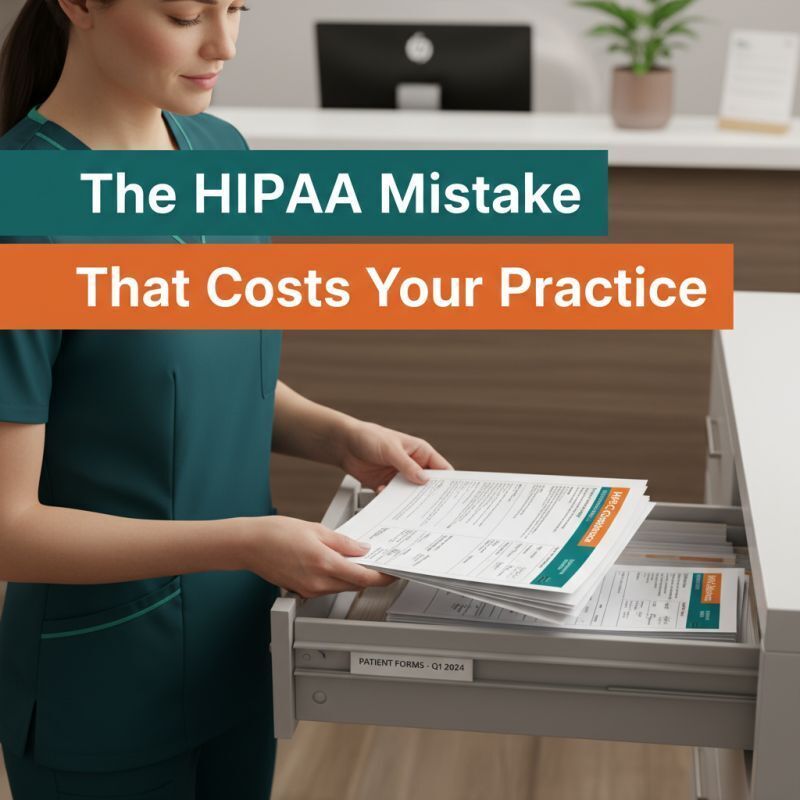
Medical practices in Boca Raton face up to $2.1 million in HIPAA fines per violation tier — and improperly designed paper forms are one of the most overlooked compliance gaps. Your patient intake process is often the first place protected health information (PHI) is collected, which makes the quality of your printed forms a direct line of defense. Minuteman Press Boca Raton designs and prints custom HIPAA-compliant forms that protect your practice, support your EHR system, and hold up under audit.
Why Your Printed Forms Are a HIPAA Risk
Most healthcare practices focus their compliance efforts on digital systems — EHR software, encrypted email, and secure patient portals. Physical forms rarely get the same attention. That's a problem.
The U.S. Department of Health and Human Services Office for Civil Rights (OCR) closed 22 enforcement actions with financial penalties in 2024 alone, making it one of the most active enforcement years on record. Violations included impermissible disclosures, improper record disposal, and failure to conduct risk assessments — all areas where paper forms play a direct role.
When a front desk staffer hands a new patient a generic intake form from a big-box office supply store, that form may not capture the right fields, may not use plain language required by the Privacy Rule, or may not support the audit trail your practice needs. A fine that starts at $141 per violation can escalate to a $2.1 million annual cap — fast.
Custom-printed HIPAA-compliant forms reduce that exposure at the source.
What Makes a Form Truly HIPAA Compliant
HIPAA does not publish a single approved template. Compliance depends on the content, design, and workflow integration of each form. A compliant form must meet standards set by the Privacy Rule (45 CFR Parts 160 and 164).
At minimum, a HIPAA-compliant authorization or intake form must:
- Be written in plain language a patient can understand
- Clearly identify what PHI is being collected and why
- Name the party disclosing and the party receiving information
- Include an expiration date or triggering event
- Detail the patient's right to revoke authorization in writing
- Carry the patient's dated signature
Beyond regulatory language, the physical form itself matters. Paper stock, printing quality, and field layout affect whether information is legible, storable, and scannable for EHR integration. A form that smears, tears, or produces unclear carbon copies creates documentation gaps that auditors flag.
The Real Cost of Generic Forms
Generic forms create three categories of risk your practice cannot afford.
Compliance gaps. Off-the-shelf forms often omit required disclosure language, lack fields that support audit trails, or use terminology that does not align with current OCR guidance. The February 2024 Change Healthcare ransomware attack compromised data for over 100 million individuals. That event put physical documentation practices under a spotlight — practices with inconsistent or incomplete paper records had far less ability to demonstrate compliance when auditors asked questions.
Operational friction. A poorly designed multi-part form forces staff to re-enter data manually into your EHR. That manual entry is where errors occur. One transposition in a patient ID number or a missed checkbox on a consent form creates both a clinical and a legal liability.
Audit vulnerability. During an OCR investigation, your documentation tells your story. If your paper forms do not support a complete, legible, and chronological audit trail, you lose the ability to demonstrate good-faith compliance — even when no actual breach occurred.
How Minuteman Press Boca Raton Designs HIPAA-Compliant Forms
Minuteman Press Boca Raton combines college-educated graphic designers with deep experience in regulated business printing. This is not a template-and-print operation. Every form project starts with a consultation about your practice type, your workflow, and your EHR system.
The process follows a clear sequence.
Discovery. Your account manager reviews your current forms and identifies compliance gaps. This includes required field coverage, Privacy Rule language, and formatting that supports your document management workflow.
Design. A designer builds your custom form around your brand, your clinical workflow, and regulatory requirements. Field placement is designed for accuracy — both for patients completing the form and for staff scanning or entering data.
Proofing. You review every element before a single sheet prints. Field labels, consent language, signature blocks, and expiration clauses all get sign-off.
Printing. Forms are printed on the right paper stock for your intended use. Multi-part forms for procedures that require simultaneous copies use NCR (no-carbon-required) paper, producing clean, legible copies for patient records, billing, and your clinical file.
Delivery. You receive forms ready to drop into your existing intake and documentation process.
Types of HIPAA-Compliant Forms We Print
Boca Raton medical practices, dental offices, mental health providers, and specialty clinics rely on Minuteman Press for a range of clinical documentation:
Patient Intake Forms. New patient registration forms that capture demographics, insurance, and clinical history. Designed to match your EHR input screens to reduce manual data entry errors.
Authorization to Release Medical Records. Compliant with the HIPAA Privacy Rule's 8 required elements. Includes expiration dates, purpose of disclosure, and revocation rights written in plain language.
Consent for Treatment Forms. General and procedure-specific consent forms with proper signature blocks and witness fields for surgical or high-risk procedures.
Notice of Privacy Practices Acknowledgment. Required at every patient's first visit. Designed for clear patient understanding and easy staff distribution.
Multi-Part Medical Forms. NCR forms that produce simultaneous copies for different departments — billing, clinical, patient copy — without photocopying or rescanning.
Referral and Transfer Documentation. Structured for inter-provider communication with built-in PHI disclosure tracking.
The Advantage of Local, Custom Printing
National print brokers ship generic templates. They do not know your practice, your workflow, or Florida's specific regulatory environment.
Minuteman Press Boca Raton is in your market. When you need a form revised after an OCR guidance update, you call a local number and speak with the same team that designed your original forms. Turnaround on reprints and revisions is measured in days, not weeks.
Palm Beach County has one of the highest concentrations of medical practices per capita in Florida. The competitive nature of healthcare here means that patient-facing materials — including the forms your patients complete at intake — reflect directly on your practice's professionalism and trustworthiness.
A well-designed intake form signals to a patient that your practice takes their privacy seriously before they see a single provider. That impression matters.
What Proper Forms Do for Your EHR Integration
Modern EHR systems are only as accurate as the data going in. When patient intake forms are designed to mirror the field structure of your EHR — whether you use Epic, Athenahealth, Kareo, or another platform — your front-desk staff spends less time interpreting handwriting or locating the right data field.
Multi-part forms reduce the transcription step entirely for workflows that use parallel documentation. When the same form simultaneously produces a patient copy, a billing copy, and a clinical file copy, your intake process moves faster and your documentation stays consistent across all three records.
Consistent records mean a cleaner audit trail. A cleaner audit trail means lower risk when OCR knocks.
When to Audit and Update Your Forms
OCR guidance evolves. Florida state law adds additional layers — particularly around mental health records (under the Baker Act), reproductive health disclosures, and minors' consent rights under Chapter 743 of the Florida Statutes.
Plan a form audit at these intervals:
- Annually as a standard compliance review
- Any time OCR updates its Privacy Rule guidance
- After a practice merger or acquisition
- When your EHR platform updates its data fields
- When you add a new clinical service or specialty
If your current patient intake forms were designed more than two years ago and have not been reviewed since, they are overdue for a compliance check.
Working With Minuteman Press Boca Raton
The process starts with a call or a visit to our Boca Raton location. Bring your current forms — even if they are printouts from a template site or inherited from a prior practice owner. We review what you have, identify what needs to change, and give you a clear quote.
There is no minimum order requirement that forces you to stockpile forms you will not use. We print in the quantities your practice actually needs, and we store your design files for fast reorders.
Practices with multiple locations can maintain consistent form design across all sites while customizing location-specific fields — address, provider names, and local phone numbers — for each site.
CONCLUSION
Your patient intake process is where PHI collection begins. It deserves the same compliance rigor as your digital systems. Minuteman Press Boca Raton designs and prints custom HIPAA-compliant forms that protect your practice, support your staff, and hold up under scrutiny. Call us at 561-392-8626 or REQUEST AN ESTIMATE HERE. We work with medical practices, dental offices, mental health providers, and specialty clinics across Palm Beach County and South Florida.
FAQ SECTION
Q: Do medical practices in Boca Raton need custom-printed HIPAA forms, or can they use templates downloaded online? A: Downloaded templates carry risk. HIPAA does not provide an approved form — compliance depends on your specific practice type, disclosure language, and workflow integration. A template written for a primary care practice in another state may not address Florida-specific requirements under the Baker Act or minors' consent statutes. Custom forms designed for your practice and printed locally give you control over compliance and documentation quality.
Q: How often should a Palm Beach County medical practice update its patient intake forms? A: Plan a review at least annually. OCR updates enforcement priorities, and Florida law has specific provisions — particularly around mental health documentation, reproductive health disclosures, and minors — that require forms to stay current. Any time your EHR system updates its data fields or you add a clinical service, revisit your forms.
Q: What is NCR printing, and why do medical practices use multi-part NCR forms? A: NCR stands for no-carbon-required. Multi-part NCR forms produce simultaneous legible copies in a single writing — one for the patient, one for billing, one for the clinical file. This eliminates photocopying and rescanning steps, reduces transcription errors, and produces a consistent audit trail across all copies. Minuteman Press Boca Raton prints custom NCR forms for medical and dental practices throughout South Florida.
Q: Can Minuteman Press Boca Raton design forms that integrate with my EHR system? A: Yes. Our designers review your EHR's input screens and mirror the field structure on your printed forms. This reduces manual data entry errors at the front desk and speeds up the intake process. We have worked with practices using Epic, Athenahealth, Kareo, and other major platforms.
Q: What HIPAA penalty risk does a Boca Raton practice face if its forms are non-compliant? A: Civil penalties under HIPAA range from $141 per violation at the lowest tier to an annual cap of over $2.1 million per identical violation category. In 2024, OCR closed 22 enforcement actions with financial penalties — including actions against small and mid-sized practices. Non-compliant paper forms can contribute to violations related to impermissible PHI disclosure, failure to obtain proper authorization, and inadequate audit trails.